The Operator's Guide to Structural Tent Setup: Load Calculations and Site Prep for Large Events

The Operator's Guide to Structural Tent Setup: Load Calculations and Site Prep for Large Events
When you’re running a large event, the tent isn't just a roof; it's a major piece of temporary architecture. A successful setup hinges entirely on the steps taken before the first pole is unscrewed. Most operators treat tent setup like following a diagram, but the reality is that you are managing physics, soil mechanics, and local code compliance simultaneously. Your liability starts the moment you accept the booking, and it ends only when the structure is safely dismantled. This guide moves beyond the basic checklist and focuses on the engineering protocols that separate a smooth setup day from a costly, dangerous failure.
The single most common mistake we see—and the one that gets operators in the most trouble—is assuming that because the tent looks fine, it is fine. A structure must be designed for the worst-case scenario, not the average day. This means understanding wind load, lateral forces, and ground stability. Before you even pull out the pole bags, you need a site plan that addresses these physical realities. The most actionable insight you can take away today is to mandate a minimum two-person site assessment team that includes one person focused solely on geotechnical conditions and one focused solely on meteorological data.
Assessing the Ground: Geotechnical Stability and Bearing Capacity
The ground is the foundation, and treating it as a uniform surface is a recipe for sinking poles and shifting loads. Bearing capacity is the maximum pressure the soil can support without failing. If the pressure exerted by your tent's anchor points (and the weight of the tent itself) exceeds the soil’s capacity, you get differential settlement—meaning parts of the structure sink at different rates, creating stress points that can lead to collapse.
Understanding soil type is non-negotiable. Are you on compacted clay, loose sand, or rocky loam? Each requires a fundamentally different anchoring approach. For instance, setting up a large, heavy ballroom tent on wet, organic topsoil requires much more extensive ground preparation (like laying a temporary gravel pad) than setting it up on dry, compacted gravel. A simple ground stakes system will fail immediately in soft, saturated earth.
Real-World Scenario: We once encountered a setup on a field that had been recently watered for a nearby landscaping project. The surface appeared solid, but the underlying soil was highly saturated clay. The initial anchors, designed for dry ground, began to creep and pull out under the slightest lateral wind load, causing the entire corner of the tent to tilt noticeably within the first hour. The solution required immediate weight distribution changes and temporary ballast until the ground could be stabilized or reinforced with a gravel mat.
Understanding the Forces: Wind, Snow, and Live Loads
When calculating structural loads, you must account for three primary forces: dead load, live load, and environmental load. The dead load is the weight of the structure itself (poles, fabric, frame). The live load is anything temporary placed on the structure (people milling around, tables, vendor equipment). The environmental load is the big one—wind and snow.
Wind is the most critical factor. It doesn't just push on the side of the tent; it creates lift and drag. A large, taut fabric surface acts like a sail, exponentially increasing the force exerted on the anchors and poles. You must consult the local, specific wind forecast for the event date, not just the general weather outlook.
- Wind Mitigation Protocol:
For a detailed look at how we manage complex structural requirements for our clients, you can review our portfolio of completed setups at https://demo.partyrentalcommand.com/.
The sheer magnitude of these structural considerations—the interaction between the ground, the environment, and the materials—underscores that structural integrity is a holistic, site-wide concern. It requires coordinating site prep with engineering knowledge.
The Anchoring System: From Stakes to Ballast
Anchoring is where most operators cut corners, assuming that a handful of stakes driven into the ground are sufficient. They are not. The anchoring system must be designed to counteract the calculated environmental forces. The choice between stakes, water weights, and concrete ballast depends entirely on the soil type and the expected wind load.
If you are dealing with high winds and unknown soil conditions, never rely on stakes alone. A layered approach is necessary.
- Site Survey: Determine soil composition and water table depth.
- Load Calculation: Determine the maximum expected wind pressure (PSI).
- System Selection: Choose anchoring method (e.g., heavy ballast plus ground stakes).
- Installation: Install anchors according to the manufacturer's specified spacing and depth.
Concrete Example: For a large marquee tent in a known, stable gravel area, we might use heavy, custom-weighted concrete anchors set into deep holes. If the site is soft lawn, we would abandon deep anchors and instead use a combination of perimeter gravel mats and numerous, interconnected water barrels filled with concrete ballast, distributing the load over a much wider, more stable area.
Site Management and Safety Protocols
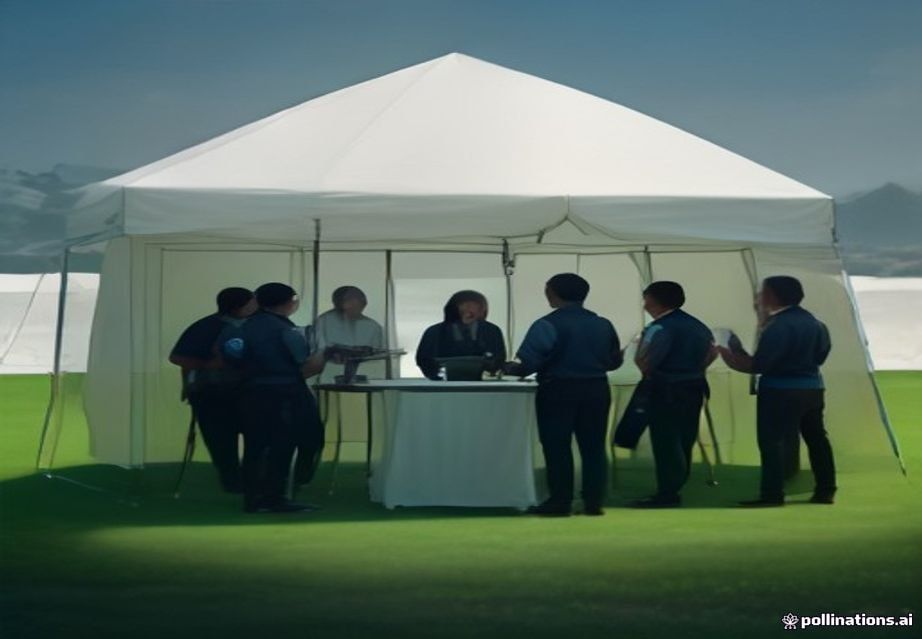
The setup day is not just a construction day; it’s a safety operation. Every step must be managed with a clear chain of command. Before any pole is lifted, the site manager must enforce specific protocols. This involves more than just wearing hard hats; it involves documented roles and responsibilities.
Assigning specific roles is crucial:
- Safety Officer: Responsible for checking PPE, monitoring lift points, and enforcing safe lifting practices.
- Ground Lead: Responsible for executing the geotechnical survey, ensuring proper ground prep (clearing debris, leveling, marking anchor points), and managing the ballast supply.
- Structural Lead: Responsible for verifying the correct pole sizes, hardware, and following the manufacturer's installation sequence.
The site manager must maintain a constant dialogue with all crew members, ensuring that no task proceeds without the necessary safety sign-off. This proactive approach minimizes delays and, more importantly, prevents accidents.
Managing the Unexpected: Contingency Planning
The most professional operators are not the ones who avoid problems; they are the ones who have already planned for them. The "unexpected" is a guaranteed part of any large outdoor event. Contingency planning must be a documented, rehearsed process, not an afterthought scribbled on a notepad.
Emergency communication protocols must be established immediately upon arrival. This means having dedicated radio channels for different teams (e.g., "Team Alpha: Setup," "Team Bravo: Catering," "Command: Site Manager"). If a pole snaps, or if a section of the tent is damaged by equipment, everyone must know who to call and what the immediate, safe procedure is.
- Unexpected Vendor Delays: If the generator delivery is delayed by two hours, the structural lead must immediately re-prioritize tasks. Instead of waiting for the power, the team should focus on tasks that don't require electricity, such as laying out perimeter weights, marking the final footprint, or pre-assembling non-powered sections. Never let a delay halt all progress; always shift to the next available, safe task.
- Immediate Structural Triage Procedures: If high winds suddenly increase, the structural lead must have the authority to issue a "Code Yellow" (slow down, secure loose items) or "Code Red" (immediate, controlled evacuation and structural bracing). Everyone must know the emergency shut-down points for the structure.
***
Site Manager's Quick Checklist: Non-Negotiable Pre-Setup Steps
Before any pole is handled, the Site Manager must verify the following 7 items. These are the points that, if missed, introduce unacceptable liability risk.
- Utility Clearance: Call 811 (or local equivalent) and confirm all underground utilities (gas, electric, water) are marked and clear of the proposed footprint.
- Soil Verification: Perform a physical survey to determine soil type (sand, clay, loam) and confirm the ground is free of debris, roots, or unexpected obstacles.
- Wind Forecast: Review the 48-hour wind forecast. If maximum sustained winds exceed the operational limit, the event cannot proceed.
- Anchoring Material: Confirm the correct anchoring material (ballast, stakes, etc.) is on site and matches the calculated load requirements.
- Safety Briefing: Conduct a mandatory, documented safety meeting for all crew members, assigning clear roles and emergency protocols.
- Weather Contingency: Confirm access to a secondary, covered staging area for equipment and personnel in case of sudden rain or high wind.
- Insurance/Permits: Verify that all required local permits and liability insurance documentation are physically present and current.
***
Mastering structural setup is less about following a diagram and more about disciplined, site-specific risk management.
Always treat the site as if the worst-case weather scenario is already happening.
Ready to turn searches into booked jobs?
Websites and booking systems built only for party rental companies.